Brain Mapping for Kids: See What Is Really Going On in Your Child's Brain
Brain Mapping for Kids: See What Is Really Going On in Your Child's Brain
If you are reading this, you have probably already tried a lot.
The reward charts. The earlier bedtimes. The endless meetings with school. Maybe an assessment or two that gave your child a label but no real answers.
And still, the same questions keep you up at night. Why can't he focus for more than a few minutes? Why does she still struggle to fall asleep? Why is his speech behind the other kids? Why do the meltdowns come out of nowhere?
Here is something most parents are never told. You do not have to guess. You can actually look.
What is a brain map?
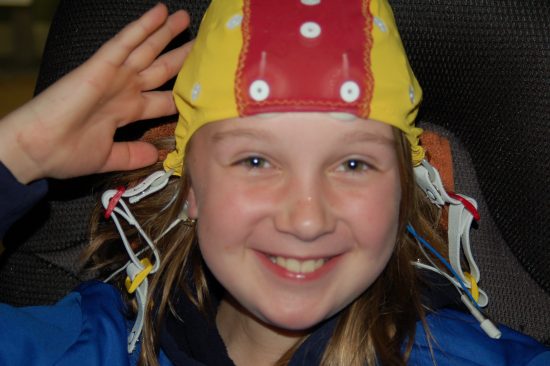
A brain map, sometimes called a QEEG, is a safe and painless way of measuring your child's brain activity. Your child wears a soft cap with small sensors that read the electrical signals their brain naturally produces. Nothing goes into the brain. Nothing hurts. Your child just sits comfortably while the sensors listen.
Those signals are then turned into a detailed picture of how your child's brain is working. Which areas are overactive. Which are underactive. And crucially, how well the different parts of the brain are talking to each other.
Think of it like this. If your child had a persistent tummy ache, you would want a scan before anyone started treating it. A brain map does the same job for focus, attention, sleep, speech and emotional regulation. It shows you what is actually happening instead of leaving everyone guessing.
Why hemisphere connectivity matters so much
Your child's brain has two hemispheres, and they are supposed to work as a team. The right side develops first and handles things like big picture thinking, reading emotions, body awareness and self regulation. The left side handles language, detail and logic.
In many children who struggle with focus, speech or behaviour, one hemisphere is racing ahead while the other lags behind. The two sides are not connecting and communicating the way they should.
When that happens, you see it in daily life. A bright child who cannot sit still. A chatty child who cannot follow instructions. A sweet child who flips into meltdown in seconds. It is not naughtiness and it is not bad parenting. It is a connection problem, and a brain map lets us see exactly where it sits.
What this actually means for you as a parent
This is the part that matters. Not the technology, but what it gives you.
You finally get answers instead of opinions. Everyone has a theory about your child. The teacher, the grandparents, the parents at the school gate. A brain map replaces opinion with data. You see, in colour, why your child struggles with the things they struggle with.
You stop wasting time and money on guesswork. When you know which areas of the brain are out of balance, support becomes targeted. No more trying ten different things and hoping one sticks.
You get a starting point you can measure against. Because the brain map gives us a clear baseline, you can see real change over time. Not "I think he seems a bit calmer" but actual measurable progress.
You understand your child differently. Parents tell us this all the time. Once they see the map, the guilt lifts. The frustration softens. You stop asking "why won't my child behave" and start asking "how can I support my child's brain". That shift changes everything at home.
Focus, sleep and speech: what the map reveals
Focus and attention. Children who struggle to concentrate often show too much slow wave activity in the front of the brain, the area responsible for attention and impulse control. In simple terms, the part of the brain that should be wide awake in class is running half asleep. Once we can see it, we can train it.
Sleep. A brain that cannot switch off at night usually shows too much fast activity, a nervous system stuck in high alert. The map shows us where, which means bedtime battles can finally be addressed at the source rather than with another sticker chart.
Speech and language. Speech relies heavily on the left hemisphere and on strong communication between both sides of the brain. When a child's speech is delayed or unclear, the map often shows us underactivity or poor connectivity in these areas. That tells us exactly where to focus.
The best news: imbalances can be corrected
Here is what we want every parent to know. The brain can change. It is called neuroplasticity, and it means that with the right input, at the right intensity, weaker areas can be strengthened and the two hemispheres can learn to work together properly.
That is the whole foundation of our work at Hopeful Neuron. Your child is not the problem. Their nervous system needs support. The brain map simply shows us where that support needs to go, so nothing is left to chance.
What happens at a brain map session
The session is relaxed and child friendly. Your child sits in a comfy chair wearing the sensor cap, a bit like a swimming cap with buttons on it. We record their brain activity with eyes open and eyes closed. Most children find it interesting rather than scary, and we go at your child's pace throughout.
Afterwards, we sit with you and walk through the results in plain English. No jargon, no rushing. You leave knowing what the map shows, what it means for your child's focus, sleep, speech and behaviour, and what can be done about it.
Is a brain map right for my child?
If your child struggles with any of the following, a brain map will give you real insight:
Poor focus and attention at school or home
Trouble falling asleep or staying asleep
Delayed or unclear speech
Big emotions, meltdowns or anxiety
A diagnosis like ADHD or autism, or no diagnosis but a gut feeling that something is not quite right
You do not need a diagnosis to book. You just need to want answers.
Ready to see what is going on inside your child's brain?
We run brain mapping sessions at our clinic in Mill Hill, London, and at special brain mapping weekends across North London. Spaces are limited because every family gets proper one to one time with us.
If you have spent months or years wondering what is going on with your child, this is the closest thing there is to a look inside. Book your child's brain map or start with a free 15 minute discovery call at hopefulneuron.com/calendar and let's find out together.
Adi and Dana Latter are certified Melillo Method practitioners and the founders of Hopeful Neuron, a neurodevelopmental clinic in Mill Hill, London. They have supported over 200 families with focus, attention, sleep, speech and behaviour challenges, in clinic and remotely worldwide.
