"Dana and Adi are a great team, incredibly knowledgeable and supportive. Even after completing the Intensive week they continued supporting us, answering any concerns with confidence and care. They always found a way to help our son and gave us the strength to do the same at home."
Your child is not the problem.
Their nervous system just needs the right support.
We made this because parents kept telling us the same thing. They had already tried a lot of things. They were tired. They just wanted someone to say: here is what to do, at home, today, without booking anything or waiting for anyone. So that is what this is. Simple movements. Fifteen minutes a day. No equipment. It is not going to fix everything. But if you do it consistently, most families start noticing things within a few weeks. Small things first. Then bigger ones. This page covers what retained primitive reflexes are, how to recognise them, how they affect learning and behaviour, how they relate to vestibular development and sensory integration, and what you can do at home. The course gives you the practical exercises.
Access
"Dana and Adi are a great team, incredibly knowledgeable and supportive."
Faranak B., LondonSigns your child may have
retained primitive reflexes
Most parents who find us have already been trying for a while. Googled things at midnight. Chased referrals. Sat on waiting lists. Tried things that helped briefly and then stopped. If that is you, you are not missing something obvious. What you probably have not had is a clear explanation of retained primitive reflexes — what they are, what the signs look like, and what targeted exercises can do at home. That is what this page is for.
- "My child is struggling and I genuinely do not know what else to try."
- "The waiting list is months long and my child is struggling right now, today."
- "We have tried a lot of things. Some helped for a bit. But nothing has actually changed."
- "Watching my child struggle with things that other children just do without thinking is exhausting and heartbreaking."
- "I just want someone to tell me what to do. At home. Every day. Without it being complicated."
What are retained primitive reflexes
and why do they matter for your child?
What are retained primitive reflexes?
Retained primitive reflexes are automatic survival reflexes that every baby is born with. In typical neurodevelopment, these reflexes are integrated and switched off during the first one to two years of life. When integration does not happen fully, the reflexes remain active and create ongoing interference in the nervous system — affecting a child's focus, motor coordination, sensory processing, emotional regulation and bilateral coordination.
Retained primitive reflexes are not a diagnosis. They are a neurological pattern that can be addressed through specific, consistent primitive reflex integration exercises — which is exactly what this free course teaches.
How primitive reflexes develop in early childhood
Primitive reflexes emerge in the womb and are fully present at birth. Each reflex serves a specific survival purpose — the Moro reflex protects the newborn from falling, the rooting reflex helps them find food, the palmar grasp reflex ensures they hold on. In the first months of life, the brain begins developing higher-level motor control. As it does, these primitive reflexes are gradually suppressed and replaced by voluntary movement. This process, called primitive reflex integration, is driven by neurological maturation — specifically by the development of the cerebral cortex, which takes over from the brainstem.
Normal reflex integration depends on two things: adequate neurological maturation, and sufficient movement experience. Babies who have limited tummy time, who skip crawling, or who experience stress during early development may not complete the integration process fully. When primitive reflex integration is incomplete, the lower brain continues running automatic reflex patterns that should have been replaced by cortical control.
The exercises in this course replicate and stimulate the natural movement sequences that should have integrated these reflexes during infancy. By creating the same sensorimotor input the brain was originally waiting for, we give the nervous system the opportunity to complete what it did not finish.
Every baby is born with primitive reflexes — automatic survival movements present from birth. In typical neurodevelopment, these reflexes are gradually integrated and replaced by voluntary, controlled movement during the first one to two years of life. When primitive reflex integration does not complete fully, some reflexes remain active in the nervous system. These are called retained primitive reflexes.
Retained primitive reflexes are more common than most people realise. We see it regularly in children who seem bright and capable but are struggling in ways that do not quite add up — with focus, with coordination, with emotional regulation, with sensory processing. Their difficulties are not about effort or intelligence. They are about a nervous system that never completed its early developmental work.
Retained primitive reflexes create interference across multiple neurological systems simultaneously — sensory processing, vestibular development, bilateral coordination, motor planning and emotional regulation. These are not separate problems with separate causes. They are all expressions of the same underlying pattern. The signs below show how retained reflexes appear in a child's daily behaviour and learning.
Retained reflex signs: focus and attention
- Cannot sit still for more than a minute or two
- Gets up constantly during meals or homework
- Loses concentration the moment something else moves or makes a sound
- Seems to hear instructions but cannot follow through on them
Retained reflex signs: movement and motor coordination
- Trips over their own feet regularly
- Avoids crawling, rolling, or floor-based play
- Has difficulty with bilateral coordination, using both sides of the body together
- Poor posture that keeps collapsing no matter how many times you remind them
Retained reflex signs: sensory processing difficulties
- Reacts strongly to textures, clothing tags, or having their hair brushed
- Overwhelmed by busy or noisy environments
- Seeks constant movement or craves heavy input like being squeezed or pressed
- Motion sickness or strong reactions to spinning and swinging
Retained reflex signs: emotional regulation
- Meltdowns that seem disproportionate to what triggered them
- Difficulty recovering once upset, can take hours to come back down
- Extreme reactions to transitions or changes in routine
- Heightened anxiety, particularly in new or unpredictable situations
Not every child will show all of these signs of retained primitive reflexes, and some will show them more strongly than others. What we look for is a cluster of things that do not quite fit together — pointing toward a nervous system that needs neurodevelopmental support.
Mild reflex retention
Signs that are present but manageable. Child functions reasonably well but with noticeably more effort than peers. Often described as "a bit clumsy" or "highly sensitive" rather than having a clear diagnosis.
Moderate reflex retention
Daily life is significantly affected. School is hard. Home is hard. Multiple areas — focus, coordination, regulation — are all showing signs. Most families in this course fall into this category.
Strong reflex retention
Multiple reflexes active, significant impact across all areas. These children benefit most from a combination of home practice and direct clinical support. This course is still useful but works best alongside our intensive programme or remote support.
If you are seeing several of these regularly, that is worth taking seriously. This course gives you something practical to do straight away. If the picture feels more complex or you are not sure where your child falls, a free call with us is the right starting point. What matters most right now is that you have somewhere to start.
Vestibular system development in children
and why it affects so much more than balance
The vestibular system is one of the earliest sensory systems to develop in a baby. Most parents know it has something to do with balance — but vestibular system development in children connects to almost every other neurological system in the body. When vestibular processing is not working efficiently, the effects show up as attention difficulties, poor posture, reading problems, emotional dysregulation, and sensory sensitivities. These are easy to misattribute as behavioural problems or learning difficulties.
Vestibular system development is closely linked to proprioception development — the body's sense of where it is in space and how much force its muscles are using. When both are underdeveloped, children often appear clumsy, seek intense physical input, or struggle with fine motor tasks like writing. The vestibular and proprioceptive systems develop together. This is why effective primitive reflex integration exercises address both systems simultaneously rather than in isolation.
What vestibular system development controls in children
The vestibular system sits in the inner ear and is responsible for processing movement, gravity, and spatial orientation. It tells the brain where the body is in space and how it is moving.
But that is just the beginning. Vestibular processing is directly connected to:
- →Eye tracking and reading — the ability to follow a line of text without losing the place
- →Postural control — holding the body upright without conscious effort
- →Attention and arousal — regulating how alert and focused the brain stays
- →Language development — timing and coordination of speech
- →Emotional regulation — helping the nervous system settle after stress
Signs of vestibular processing difficulties in children
A child whose vestibular system is under or over-responsive may show some of these patterns. Most families see a mix of both.
- •Slouching or draping over furniture constantly
- •Craving spinning, swinging or rough-and-tumble play beyond what seems typical
- •Car sickness or strong discomfort with certain types of movement
- •Difficulty learning to ride a bike, skate, or climb
- •Losing the place when reading or skipping lines
- •Difficulty knowing where the body is without looking at it
- •Bumping into things, misjudging distances, poor proprioception
Many of the primitive reflex integration exercises in this course directly support vestibular system development in children. Not as an isolated target, but by giving the nervous system the movement input it needs to build better integration across all these connected neurological functions.
Results of primitive reflex integration exercises
what parents notice, and when
We are not going to tell you this changes everything in a week. It does not. In the first few days it can honestly feel like nothing is happening at all. Some parents feel like they are doing the exercises wrong or that their child is one of the ones it will not work for. That feeling is normal. Keep going. Because when families do stick with it, things start to shift. Here is what parents actually tell us they notice first. And if, after a few weeks of consistent practice, things feel like they are not moving at all, that is something we can look at together. Sometimes the picture is more complex and needs more than a home programme. We are honest about that.
We are not talking about sitting still for an hour. At the start, some children can barely manage two minutes before getting up, lying on the floor, or finding something else to look at. Parents tell us there is a moment where that starts to change. They stay. They come back. They finish things.
They do not disappear. We want to be honest about that. But parents tell us they start getting shorter. And the time it takes to come back from one starts to come down too. That might not sound like much. But if you have spent months managing hour-long shutdowns over small things, shorter and faster is everything.
We see this a lot with children who have always been a bit clumsy, who trip over their own feet, who avoid climbing or jumping or anything where they might fall. They start taking small physical risks. Slowly. But they start. Most parents did not expect this one to show up as early as it does.
The grip loosens. The letters start going roughly where they should. A few parents have told us the class teacher mentioned an improvement before the parent even noticed it themselves. That tends to happen when you are too close to see the small shifts.
This is the one that surprises parents most. They are not expecting it. But when the nervous system is not working so hard just to manage the basics, language tends to follow. We see it often. It is rarely sudden or dramatic. But parents notice it. Usually when their child says something clearly in a moment of stress and they think, that is new.
When a child has been in a dysregulated state all day, by evening there is a lot to unravel. Parents describe it as a second job. When the load during the day starts to come down, the evenings change. Not immediately. But parents often notice it before they notice anything else. The house just feels a little quieter. A little calmer. Enough to breathe.
How long does primitive reflex integration take?
a realistic timeline for parents
One of the most common questions parents ask is: how long does primitive reflex integration take? The honest answer is that it depends on the child, the number of reflexes retained, and the consistency of practice. Progress is rarely linear. But there are recognisable patterns. Here is how improvement typically unfolds when families are consistent with daily primitive reflex exercises.
Weeks 1 to 3
Often feels like nothing is happening. This is normal. The nervous system is processing the input before it shows up as visible change. Some children become slightly more tired than usual in the first week or two. This is a sign the work is reaching deep enough.
- Sleep may improve slightly
- Child may seem a little calmer in the evenings
- Some parents notice slightly less resistance to transitions
Weeks 4 to 8
This is when most parents first notice something specific. It tends to be one thing — not a general improvement, but a moment. A task that went differently. A meltdown that did not happen. A word that came out more easily.
- Attention window begins to lengthen
- Physical coordination starts to improve
- Meltdown recovery time comes down
Months 2 to 4
Changes start to compound. What began as occasional positive moments starts to become more consistent. Posture improves. Handwriting loosens. The child starts to look more comfortable in their body. Teachers may begin to comment.
- Sustained attention in school improves
- Bilateral coordination and fine motor skills develop
- Emotional regulation becomes more consistent
Month 4 onwards
Reflex integration is not a one-time event. Some patterns take longer than others. But by this stage, families who have been consistent typically describe a child who feels fundamentally different to manage — not because the child has changed, but because the nervous system is no longer fighting itself.
- Sensory sensitivities often reduce significantly
- Independence in daily routines increases
- Social confidence often follows physical confidence
These are general patterns based on what we see working with families. Every child moves at their own pace. Some see shifts earlier. Some take longer. The only thing that consistently predicts progress is consistency in doing the exercises. That is the one variable families control.
How retained primitive reflexes affect learning
attention, behaviour and school performance
When a child is struggling at school, the assumption is usually that they need more practice, more support, or a different teaching approach. Sometimes that is true. But in many children with retained primitive reflexes, the difficulty is happening at a neurological level below the learning itself. The nervous system is too busy managing retained reflex patterns to give the brain full access to what it is capable of.
| When this reflex is retained... | Parents and teachers often see... | What is actually happening |
|---|---|---|
| Moro reflex (startle reflex) |
Hypersensitivity to sound, light or unexpected touch. Anxiety, emotional outbursts, difficulty concentrating in busy environments. | The nervous system is stuck in a low-level state of alert, treating ordinary sensory input as potential threat. |
| ATNR (asymmetrical tonic neck reflex) |
Difficulty with handwriting, mixing up letters, poor bilateral coordination, struggles crossing the midline during reading or writing tasks. | The reflex links head turning to arm extension, making it physically harder to coordinate the two sides of the body independently. |
| STNR (symmetrical tonic neck reflex) |
Slouching at desks, difficulty sitting up straight, poor muscle tone in the core, trouble transitioning between sitting and standing. | The reflex links head position to arm and leg tone, making upright seated posture much harder to sustain automatically. |
| Spinal Galant reflex | Constant fidgeting, difficulty sitting in chairs, sensitivity to waistbands or clothing around the torso, bedwetting beyond typical age. | The reflex is triggered by touch along the spine, making seated posture physically uncomfortable rather than a behavioural choice. |
| TLR (tonic labyrinthine reflex) |
Poor balance, difficulty with motor planning, tendency to move rigidly or stiffly, avoidance of movement-based activities. | The reflex links head position to muscle tone throughout the body, disrupting smooth, coordinated movement and vestibular calibration. |
These are not the only primitive reflexes, and most children carry more than one. What the table above shows is that many of the things that look like attention, behaviour or learning problems have a physical and neurological explanation underneath. That is not a reason to lower expectations. It is a reason to work at the right level.
The exercises in this course target several of these reflex patterns directly. Others, particularly those connected to deeper sensory modulation or complex motor planning difficulties, may benefit from more specialist assessment alongside home practice. The developmental progression section above gives you a sense of what to expect as the work begins to take effect. If your child's picture feels complex or you are not sure where to start, that is exactly what the free call with us is for.
Free primitive reflex integration course for parents
what is inside and how it works
Can primitive reflex integration exercises be done at home?
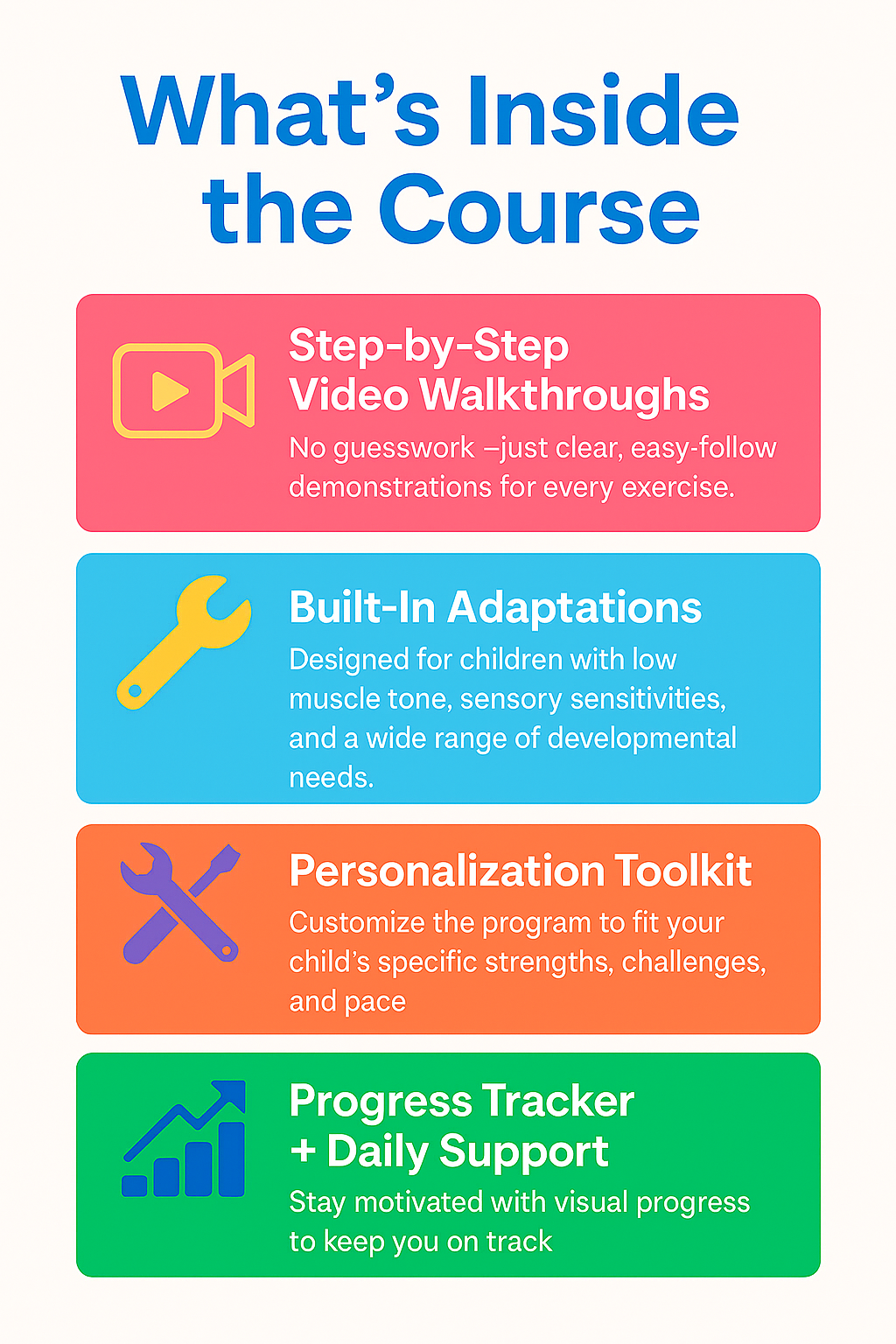
Yes. Primitive reflex integration exercises can be done at home without specialist equipment or a clinical setting. They are floor-based movement activities — crawling patterns, bilateral coordination movements, cross-lateral exercises, and simple vestibular activities — that can be done in any room. Fifteen minutes a day, done consistently, is sufficient to support neurological integration over time. This course provides step-by-step video demonstrations for every exercise.
This free primitive reflex integration course for parents is designed to be used, not just read. No lengthy background theory before you get to anything practical. Each section is short. Each exercise is demonstrated on video. You watch, you do it with your child. Most sessions take ten to fifteen minutes. That is all that is needed for consistent neurological progress.
Videos that show you exactly what to do
Every exercise is on video. Not described. Not illustrated. Shown. You press play, you copy what you see, you do it with your child. Nothing to interpret or figure out. At the beginning, most children only manage a few seconds of some exercises. That is completely normal. You do what you can.
Understand what is actually going on with your child
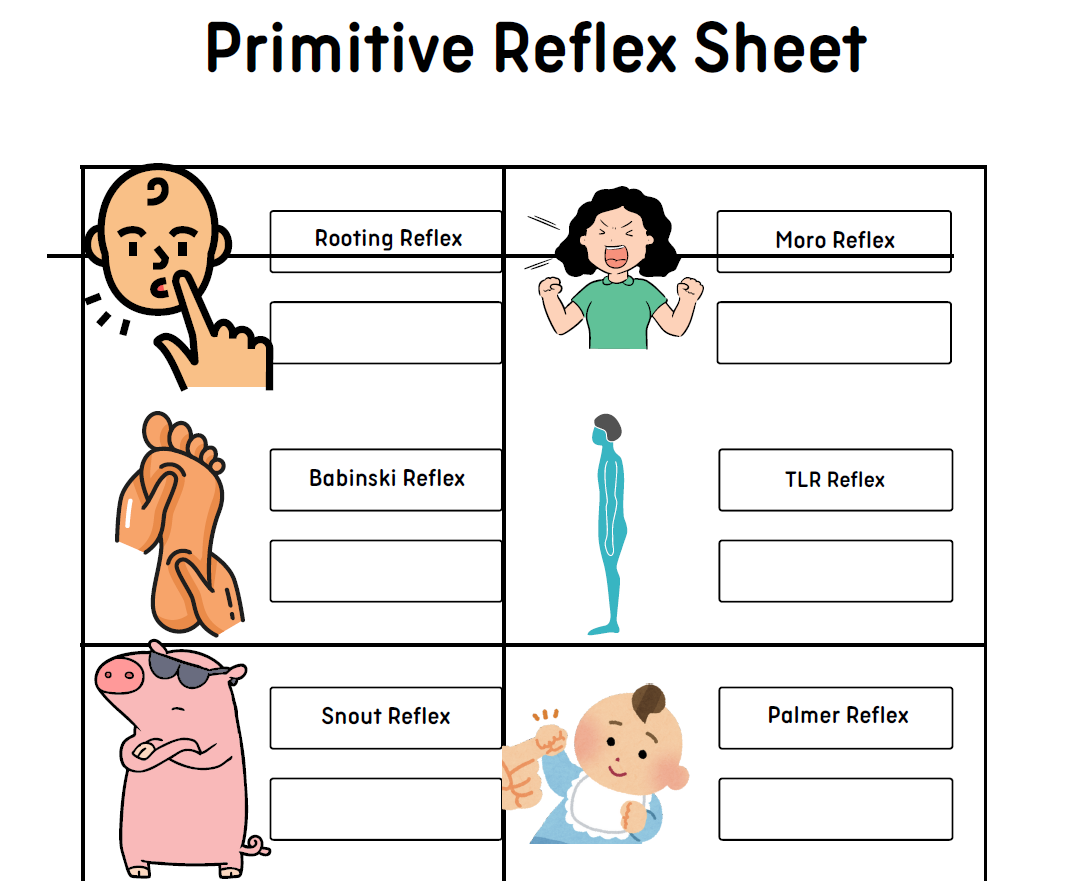
We walk you through how to recognise which reflexes might still be active and what they actually look like at home. The toe walking. The meltdown when you brush their hair. The way they avoid crawling or crossing their arms. The sensory integration that is all over the place — overwhelmed one moment, seeking intense input the next. For a lot of parents this part alone is a relief. Things that felt random and disconnected start to make sense when you understand what is driving them.
Works for your child, not some generic version of one
Every exercise has a gentler version and a harder version. If your child has very low muscle tone, or cannot follow instructions, or finds certain types of touch or movement overwhelming, there is still something here. We built it with those children in mind because those are the children we work with every day.
Start in the right place, not just the beginning
We give you a simple way to figure out where your child actually is and what to work on first. Not every child needs the same thing. And starting in the wrong place is one of the main reasons families do not see results. We try to help you avoid that from the start.
A way to notice what is shifting, even when it feels slow
Progress with these children is often quiet. It does not announce itself. One day you realise your child got dressed without a single argument and you cannot remember exactly when that started happening. The tracker helps you catch those moments earlier. That matters because there will be days when it feels like nothing is changing. Having evidence that things are shifting is what keeps most families going through those patches.
You can actually ask us things
You can email us directly. We are small. We read everything. If an exercise is not working for your child, or you are not sure if you are doing it right, or you hit a week where things feel like they are going backwards, email us. We will reply and we will try to help. You are not on your own with this.
Parent reviews of our primitive reflex programme
in their own words
"After an intensive week of functional therapy with Dana and Adi, and implementing everything we learned at home, we saw improvement in our son's behaviour. He is calmer now, his focus has improved, he's exploring everything around the house which he wasn't doing before, and his sleep has improved."
"Very caring and truly have your best interests at heart. Check-ins from Dana help to keep you focused with working on programmes at home and they are always there with support and any extra questions. Highly recommend."
About Dana Latter
primitive reflex specialist and child development expert
Dana Latter
I have been working with children for over twenty years. But none of that prepared me for the period when my own son was struggling and I had no idea what to actually do.
I tried things. I read everything. I chased appointments and sat in rooms with people who were genuinely trying to help but could not quite give me what I actually needed, which was: what do I do at home, this week, with this child. At one point I thought maybe we had just hit the ceiling of what was possible for him.
We had not. What changed things was finding an approach that worked at the level of the nervous system rather than trying to manage the symptoms on top of it. Understanding what retained reflexes actually do — how they affect vestibular processing, bilateral coordination, sensory modulation, and the capacity to regulate — changed how I looked at everything. When I saw what was possible, I could not keep it to myself. This course is what I wish had existed when we were in the worst of it. No theory. Just what to do. And why it actually works.
Why primitive reflex integration works
when other approaches for ADHD and autism haven't
When primitive reflexes are retained past early infancy, they remain active and create constant low-level interference across the nervous system. Resources that should be available for learning, emotional regulation and coordinated movement are instead being used to manage outdated survival programming.
This affects multiple systems at once. Balance and posture become harder to maintain automatically. Motor planning — organising and sequencing movement before carrying it out — requires conscious effort that it should not. Sensory modulation becomes unreliable. The child either over-responds to ordinary input or under-responds and seeks more and more stimulation just to feel regulated. Bilateral coordination and crossing the midline require effort that should be effortless. The vestibular system, which governs spatial orientation, balance, and body awareness, struggles to do its job efficiently.
This is not a behaviour problem. It is a nervous system still running early survival programming. What these neurodevelopmental exercises do is help the brain complete what it did not finish the first time. It does not happen in a week. Some children move faster than others. But when it starts to happen, the changes tend to hold — because they are coming from the foundation, not the surface.
- ✓You always know what you are doing and why. We do not just hand you a list of things to do. We explain what each exercise is targeting and what you might notice as it starts to work. That matters because there will be days when it feels pointless. Knowing the reason keeps you going.
- ✓Written for parents, not clinicians. No jargon. No lengthy background sections you have to wade through before anything useful. You do not need any therapy background to follow this.
- ✓The changes are specific, not vague. Parents do not come back to us and say "he seems a bit better." They say things like "he sat through the whole meal without getting up once" or "she walked out of the park without a meltdown for the first time ever." Those are the changes we are working toward.
- ✓Works across a wide range of children. Non-verbal children. Children with very low muscle tone. Children who cannot tolerate certain textures or sounds or types of movement. We have adapted this for all of them. There is always a version that works.
- ✓Nothing is treated in isolation. Movement, posture, coordination, emotional regulation. They are all connected. In our experience, this is why so many approaches help for a while and then stop. They are working on the output rather than the system underneath.
- ✓This is not something we read about. It is what we use every single day in our London clinic with families who have already been through the OT, the SALT, the sensory diet, the behaviour programmes. We use it because we have seen it work when other things did not.
- ✓Supports the vestibular system, proprioception and body awareness. A lot of what we are working on is connected to how the body senses itself in space, how it coordinates both sides, and how it maintains balance and posture without conscious effort. When these foundations improve, a lot of other things tend to follow.
- ✓Addresses sensory integration at the source. Sensory integration difficulties — where the brain has trouble organising and responding to sensory input — are closely connected to retained primitive reflexes. Many of the exercises in this course directly support sensory integration by providing the organised movement input the nervous system needs to process sensory information more reliably.
- ✓Reconnects developmental milestones that were missed or incomplete. Reflex integration is a developmental process that should happen in the first two years of life. When it does not, it does not disappear from the to-do list. The nervous system can still complete it. These exercises create the conditions for that to happen.
Primitive reflex integration and occupational therapy
what is different and how they work together
A question we get often is whether primitive reflex integration exercises are the same as occupational therapy exercises. They are not — though there is meaningful overlap, and many families use both alongside each other.
What occupational therapy for children focuses on
Occupational therapy (OT) typically works at the level of functional skills — the things a child needs to do in daily life. Fine motor development, handwriting, self-care tasks like dressing and eating, attention in the classroom, and sensory integration strategies.
OT is enormously valuable. Many of the children we work with are also receiving OT and making good progress. The challenge is that OT is often working on the outputs — the skills and behaviours — while the underlying neurological driver remains active.
What primitive reflex integration adds
Primitive reflex integration works one level deeper — at the neurological foundation that OT builds on. By addressing the retained reflex patterns directly, we are trying to make the brain more available for the skill-building work that occupational therapy provides.
In practice, many families who combine both approaches find that OT progress accelerates once reflex integration work is underway. The nervous system becomes less reactive, more organised, and more able to learn and retain new skills.
This is why we say the two approaches complement rather than compete. Primitive reflex integration does not replace occupational therapy. It works on the neurological layer beneath it — the layer that determines how much the OT work can stick.
- →Can be done alongside existing OT — no conflict
- →Often accelerates progress in OT sessions
- →Works on cause rather than symptom management
- →Exercises can be done at home between appointments
Free bonuses included with the primitive reflex course
Other parents who actually get it
A private group of parents doing the same thing at the same time. You can ask questions, share what is and is not working, and hear from families who are a few weeks or months further along. That last part matters more than you might think. When you are in a hard week, hearing from someone who came through one is what keeps you going.
We tell you where to actually start
When you join, tell us about your child. We will point you toward the exercises that matter most for them right now, rather than leaving you to work that out yourself on top of everything else you are already managing.
A call with us, if you want one
You can add a private 30 minute call with Adi and Dana. We look at your child specifically, answer your questions, and help you figure out where to focus. A lot of parents do this at the start when everything feels a bit overwhelming. It is optional. It is just there in case you want it.
Is this primitive reflex course right
for your child right now?
This will probably work for you if...
- Your child is between 3 and 15 and you can see they are working so much harder than other children just to get through an ordinary day
- You have had a lot of advice from a lot of different people and none of it has quite come together into something you can actually do
- You are on a waiting list and you cannot just do nothing while your child is struggling right now
- You can honestly do 15 minutes most days. Not every day. But most days, even when things are hard.
- Your child is already seeing someone and you want something practical to do at home in between sessions that actually supports the work they are doing
Probably not the right fit if...
- You are looking for something that will work without you needing to do it regularly
- You genuinely cannot do any kind of regular practice at home right now, for whatever reason
- Things are too chaotic right now to add anything at all. That is okay. Bookmark this and come back when things settle a bit.
- You feel your child needs a more comprehensive clinical assessment first. In that case, our free discovery call is a better place to start than the course.
Primitive reflex integration: frequently asked questions
Think of it like this. If your child's nervous system is spending most of its energy managing old reflex patterns in the background, there is not much left over for learning, for staying calm, for getting words out under pressure. It is like having too many things running in the background on an old laptop. Everything slows down. Everything takes more effort. Integrating these reflexes gradually takes that background load away. Parents often describe a point where their child starts accessing things that were always there. The ability was never missing. It just was not available.
Mostly floor-based. Crawling patterns, opposite arm and leg movements, simple balance activities. Nothing complicated. Nothing that looks like a therapy session from the outside. A lot of children think they are playing games. Some of them sort of are. At the beginning, many can only manage a few seconds of some exercises before they need to stop. That is fine. You start where you are.
Fifteen minutes a day. We know that sounds too small to make a difference. But what we see again and again with families is that it is not the length of the session that matters. It is doing it most days. Short and consistent beats long and occasional every time. The families who see the biggest changes are usually not the ones doing the most. They are the ones doing something every day.
Nothing you do not already have at home. A bit of clear floor space. Sometimes a ball or a chair. That is it. No specialist equipment. No therapy background needed. If you can watch something and copy it, you can do this. Most parents feel unsure the first few times. That passes quickly.
Yes. And we want to be clear about this because a lot of resources are not actually built with these children in mind. They are built for a slightly easier version and then adapted afterwards. We built this one around children with higher support needs from the beginning. There are adaptations throughout. If your child is non-verbal, has very low muscle tone, or finds certain kinds of movement or touch very difficult, there is still something here for them. We work with children like this every single week.
Yes, and we would encourage it. This is not replacing OT or SALT or anything else your child is already getting. Think of it as working on the foundations underneath. A few parents have told us their child started making noticeably faster progress in their therapy sessions once they started doing this at home as well. We think it is because a slightly more regulated nervous system is more available for that kind of work. But honestly, whatever the reason, it tends to help rather than interfere.
Of course. Life is not predictable and we are not going to pretend otherwise. You have lifetime access and there is no pressure to keep a perfect schedule. If you miss a few days, or a whole week, you just pick it back up. The only thing that actually matters is coming back to it. Every family has weeks where it falls apart a bit. That does not mean it is not working.
There is not one single sign. It tends to be a cluster of things that do not quite add up. Common ones we see in our clinic include: difficulty sitting still or maintaining posture, poor bilateral coordination, strong sensory reactions to things like clothing or hair brushing, frequent tripping or clumsiness, difficulty crossing the midline, emotional reactions that seem disproportionate to the trigger, and trouble recovering after a meltdown. If several of these sound familiar, retained reflexes may well be part of the picture. The signs section on this page goes into more detail.
It varies. Genuinely. Some families notice small shifts within the first two or three weeks. Others take longer, and for a few children the early weeks feel completely flat before something clicks. What we can say from working with over two hundred families is that consistency is the main variable. The children who make the most progress are usually the ones whose parents do a little something most days, even on hard days. Full integration of some reflexes can take months of regular work. But you do not need to wait months to see anything. Most parents notice something within four to six weeks of consistent practice.
Occupational therapy focuses on functional skills — fine motor development, handwriting, self-care, and sensory integration strategies. Primitive reflex integration works at the neurological level beneath those skills, addressing the retained reflex patterns that make functional development harder in the first place. They are not the same, but they work well together. Many families doing this course are also in OT, and a number have told us their child started making faster progress in OT sessions once reflex integration work was underway. We cover this relationship in detail in the dedicated section on this page.
The vestibular system sits in the inner ear and processes movement, gravity, and where the body is in space. Most people know it has something to do with balance. But it also connects directly to attention, eye tracking, posture, emotional regulation, and language development. A child whose vestibular system is under-responsive might need to move constantly to stay alert. One who is over-responsive might feel overwhelmed by swings, spinning, or riding in cars. Either way, it affects far more than balance. A number of the exercises in this course support vestibular processing as part of the overall nervous system work.
This is one of the most common things parents ask us, and one of the most important to understand. Intelligence and the ability to access that intelligence at any given moment are not the same thing. When the nervous system is carrying retained reflex patterns, it spends a significant amount of its available resources managing those patterns rather than supporting learning. The child is bright. But they are trying to learn while simultaneously managing a nervous system that is working harder than it should have to just to keep up. That is exhausting. And it is not a reflection of their potential.
Yes, and that is specifically what this course is designed for. The exercises do not require specialist equipment, clinical training, or a therapy setting. They are movement-based activities — crawling patterns, bilateral coordination movements, simple balance work — done on the floor at home. What matters most is not where you do them or how long each session is, but whether you do them consistently. Fifteen minutes a day, most days, is enough.
The home programme is a strong starting point for most children with mild to moderate reflex retention. If your child has a more complex profile — significant developmental delays, a recent diagnosis, very strong sensory needs, or if you have been doing the exercises consistently for eight weeks and are seeing very little change — that is a good moment to seek more direct support. We are honest about this. Our free discovery call is a good place to work out what level of input makes sense for your child right now. Sometimes home practice is enough. Sometimes it works best alongside clinical support. We will tell you which we think applies to your child.
Start integrating primitive reflexes at home.
Free course. No waitlist. No diagnosis needed.
This free primitive reflex integration course covers retained reflexes and how to identify them, vestibular system development, bilateral coordination exercises, sensory processing support, and the neurological foundations of attention and emotional regulation. Everything is demonstrated on video. No diagnosis required. No equipment needed. No waiting list. It is the same approach we use in our London clinic. Fifteen minutes a day. You can start today.
Ages 3 to 15 · 15 minutes a day · No diagnosis needed to start