"Dana and Adi are a great team, incredibly knowledgeable and supportive. Even after completing the Intensive week they continued supporting us, answering any concerns with confidence and care. They always found a way to help our son and gave us the strength to do the same at home."
14 days of brain body exercises.
Real change you can see at home.
We made this for parents who have already tried a lot of things and are tired of waiting. Each day your child does a short sequence of movements that activate all three zones of the cerebellum. The part of the brain most responsible for focus, coordination, emotional regulation and confidence. Fifteen minutes. No equipment. You can start today.
Plan
"By day 7 my son was noticeably calmer and more connected."
Parent, LondonWhy the cerebellum changes
so much more than just movement
Most people know the cerebellum has something to do with coordination. What most people do not know is that it makes up just 10% of brain volume while holding over 50% of its neurons. It connects directly to attention, emotional regulation, language and how confidently a child moves through the world.
When the cerebellum is not getting the input it needs the effects show up in ways that are easy to misread. As attention problems. As behaviour issues. As a child who seems bright but is not quite accessing what they are capable of. This programme targets all three cerebellar zones directly, in sequence, every day for 14 days.
- "My child is clearly bright but struggling in ways I cannot quite explain and nothing we have tried has actually changed anything."
- "The waiting list is months long and I need something I can do right now, this week, at home."
- "I want to understand what is actually going on underneath, not just manage what I can see on top."
- "I can do 15 minutes a day. I just need someone to tell me exactly what to do."
Three cerebellar zones.
One short routine. Every day.
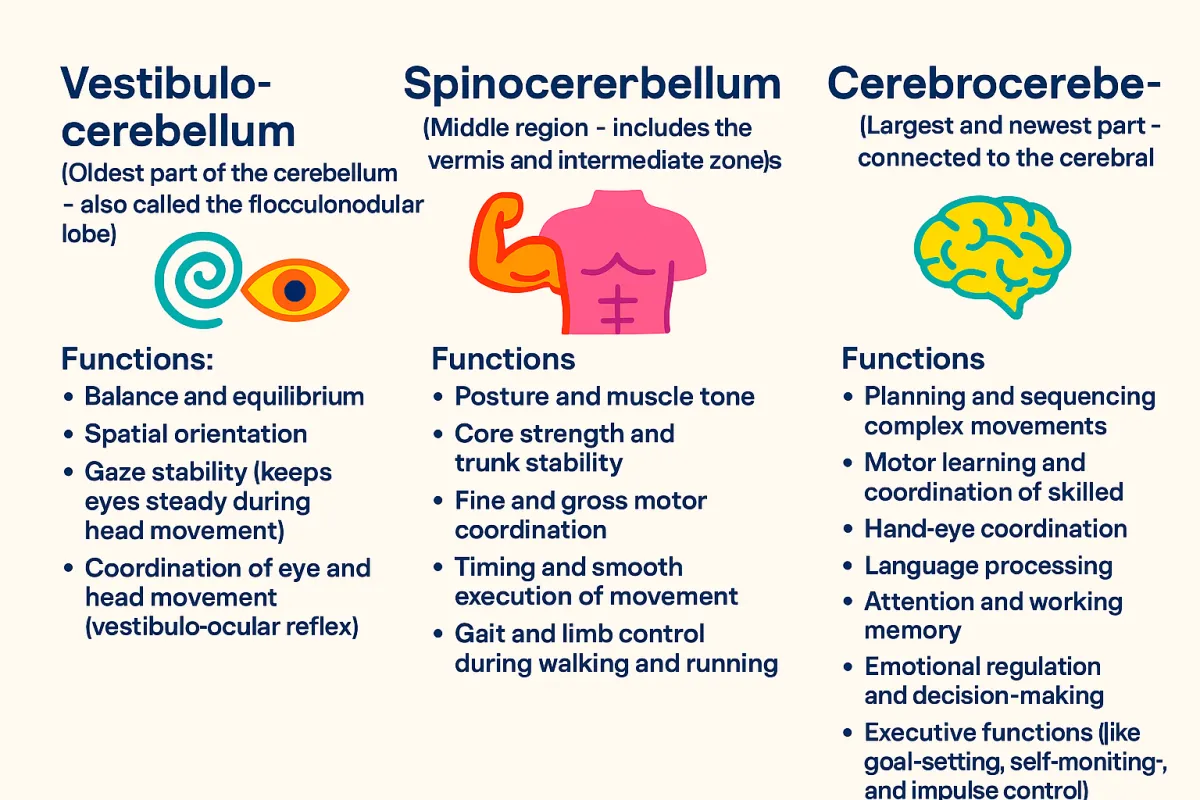
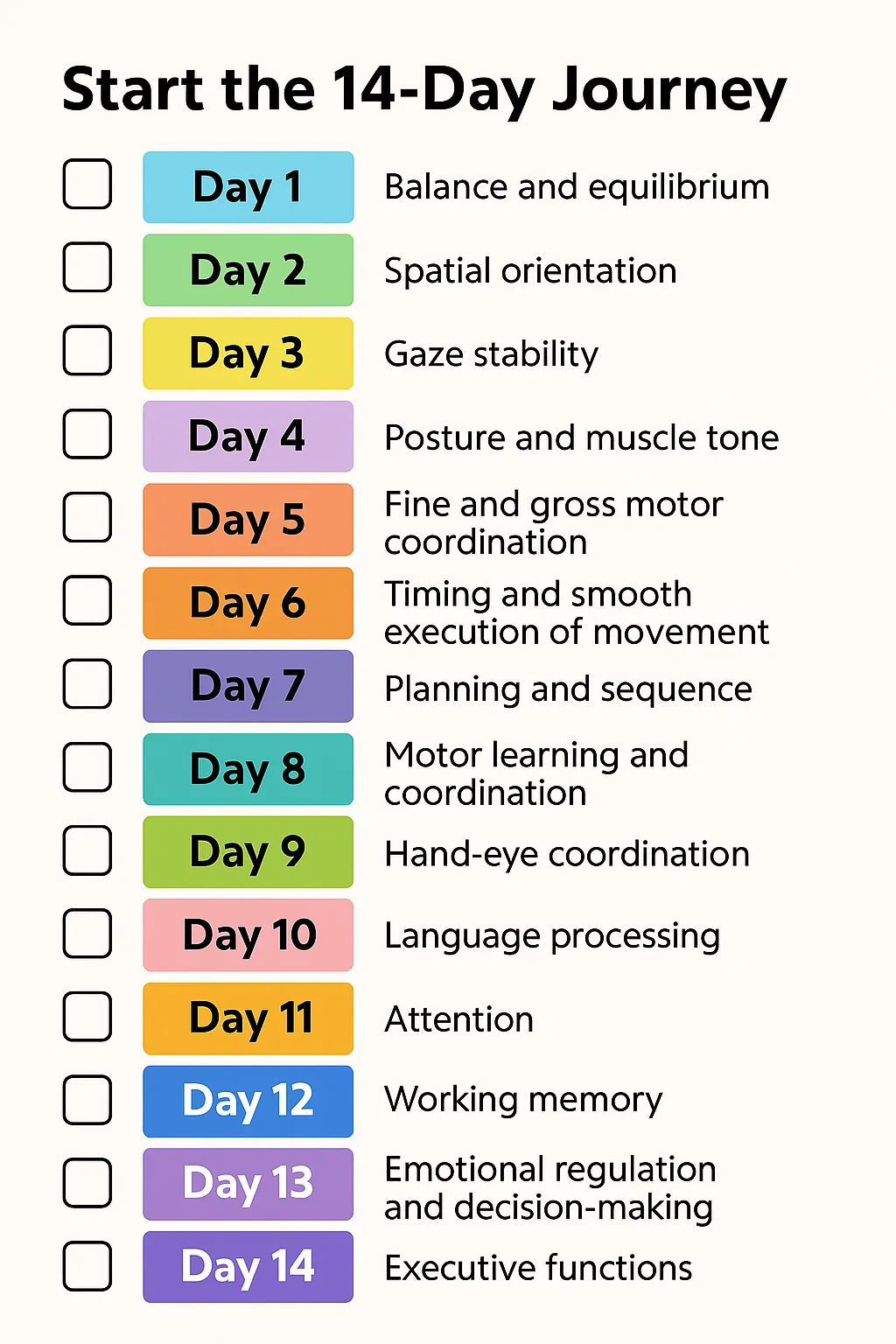
Each daily routine moves through all three zones of the cerebellum in sequence. Not one at a time. All three, working together, the way the brain actually develops. Most approaches work on one thing at a time. This one works on the whole system underneath.
This is the foundation everything else builds on. It helps children feel grounded in their body. Better balance, smoother eye tracking and a clearer sense of where they are in space. A child whose vestibulocerebellum is not getting enough input often looks clumsy, gets car sick or cannot sit still no matter how many times you ask.
This zone builds strong posture, core strength and fluid movement from sitting tall at a desk to running with control. When it is undertrained children collapse in chairs, avoid physical play or find fine motor tasks like writing much harder than they should be.
This is the zone most directly connected to the struggles parents describe at school and home. It supports attention, emotional regulation and language, helping children think, plan and express themselves more easily. When this zone gets the input it needs a lot of other things start to shift.
14 day brain body programme for parents
what is inside and how it works
Can these brain body exercises be done at home?
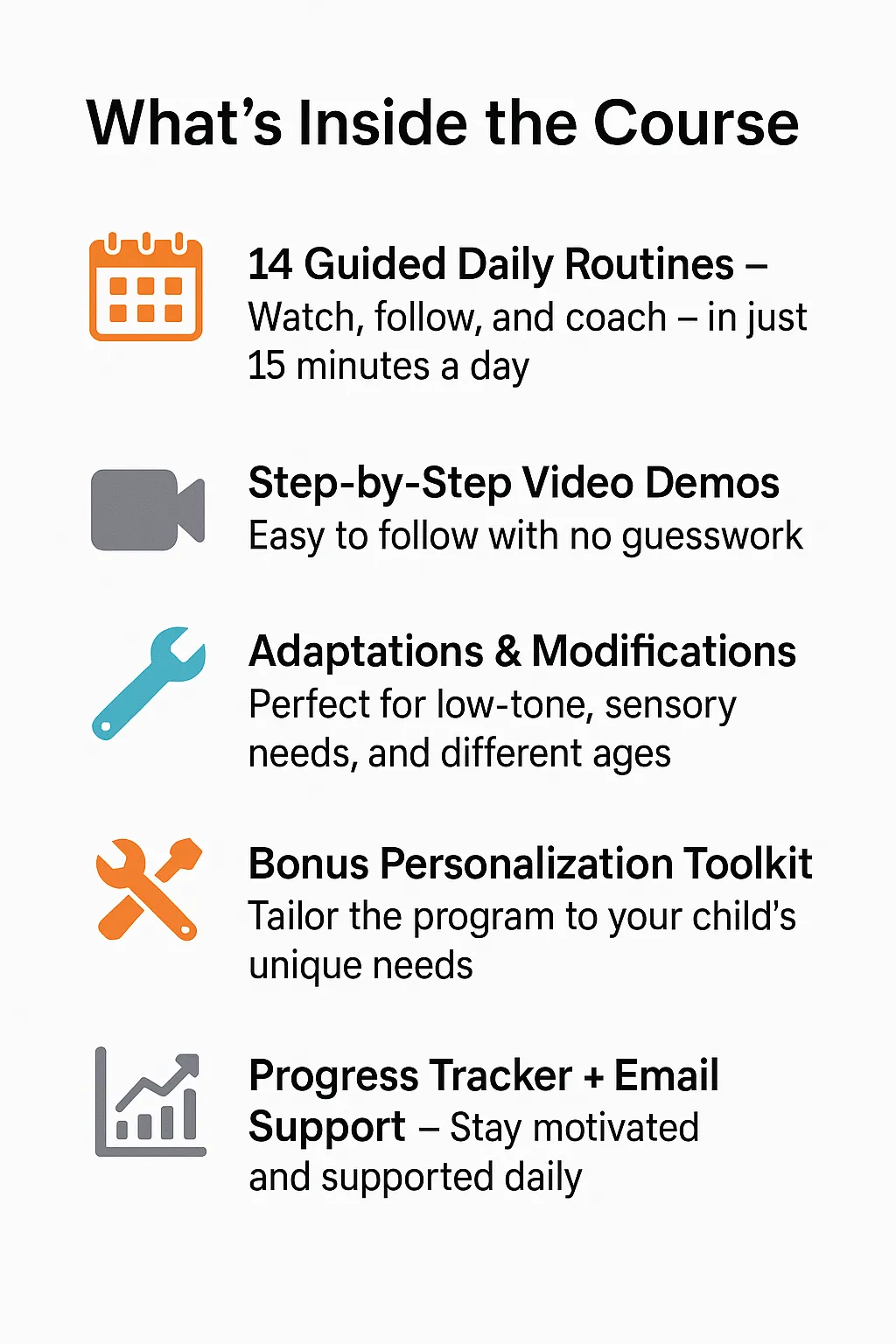
Yes. Every exercise in this programme is floor based, equipment free and demonstrated on video. You watch, you do it with your child. Fifteen minutes a day. That is all it takes for consistent cerebellar stimulation over time.
This programme is designed to be used, not just read. No lengthy background theory before you get to anything practical. Each day has its own short routine. Each exercise is on video. You press play and you do it together.
One guided routine for every day
Each day has its own short sequence so you never have to decide what to do next. The routines build on each other across the 14 days, working progressively through all three cerebellar zones. You just show up and follow along.
Every exercise shown on video
Not described. Not illustrated. Shown. You watch, you copy, you do it with your child. No guesswork at all. At the start some children can only manage a few seconds of certain exercises. That is completely normal. You start where you are and build from there.
Built for children with higher support needs
Every exercise has a gentler version and a harder version. Low muscle tone, sensory sensitivities, difficulty following instructions — there is still something here. We built this with those children in mind because those are the children we work with every single day.
Simple tools to tailor it to your child
Not every child needs the same thing. Starting in the right place is one of the main reasons families see results. We give you a simple way to work out where your child is and what to focus on first so you are not just starting at the beginning and hoping for the best.
A tracker so you can see what is shifting
Progress with these children is often quiet. It does not announce itself. One day you realise your child got through a transition without a meltdown and you cannot remember exactly when that started happening. The tracker helps you catch those moments earlier, which matters a lot on the days it feels like nothing is changing.
Email support from Adi and Dana
If an exercise is not working, or you are not sure you are doing it right, or you hit a week where things feel like they are going backwards, email us. We are small. We read everything. We reply. You are not on your own with this.
What actually changes
and when parents start to see it
We are not going to tell you this changes everything in a week. The first few days can honestly feel like nothing is happening. That is normal. Keep going. Because when families are consistent, things start to shift. Here is what parents tell us they notice first.
At the start some children can barely sit with something before getting up or finding something else to look at. Parents tell us there is a moment where that starts to change. They stay. They come back. They finish things.
Children who always seemed a bit clumsy or avoided climbing and jumping start taking small physical risks. Slowly. But they start. Most parents did not expect this one to show up as early as it does.
They do not disappear. But the time it takes to come back from one starts to come down. If you have spent months managing hour long shutdowns over small things, shorter and faster is everything.
This is the one that surprises parents most. When the nervous system is not working so hard just to get through the day, language tends to follow. Parents notice it when their child says something clearly in a moment of stress and thinks: that is new.
The grip loosens. Letters start going roughly where they should. A few parents have told us the class teacher mentioned an improvement before the parent even noticed it themselves. That tends to happen when you are too close to see the small shifts.
When a child has been in a dysregulated state all day, by evening there is a lot to unravel. When the load during the day starts to come down the evenings change. Parents notice it before they notice anything else. The house just feels a little quieter. Enough to breathe.
Why cerebellar training works
when other approaches have not
The cerebellum holds over 50% of the brain's neurons despite being just 10% of its volume. When it is not getting the right input the effects show up across attention, movement, emotional regulation and language all at once. Most interventions work on one of these things at a time. This programme works on the whole system underneath.
Each exercise gives the brain the specific sensorimotor input it needs to build more efficient pathways across all three cerebellar zones at the same time. You are not just moving. You are giving the brain something it has been waiting for.
- ✓You always know what you are doing and why. Every exercise comes with a clear explanation of what it is targeting and what you might notice as it starts to work. On the days it feels pointless, knowing the reason is what keeps most families going.
- ✓Written for parents, not clinicians. No jargon. Nothing to wade through before anything useful. You do not need any therapy background to follow this.
- ✓Built for real life families. No special equipment. No clinical setting. Just a bit of clear floor space and 15 minutes a day.
- ✓Works across a wide range of children. Non verbal children. Low muscle tone. Sensory sensitivities. We have adapted this for all of them because those are the children we work with every week.
- ✓Nothing is treated in isolation. Movement, posture, coordination, emotional regulation. They are all connected. This is why so many approaches help for a while and then stop. They work on the outputs. This works on the system underneath.
- ✓This is not something we read about. It is what we use every day in our London clinic with families who have already been through the OT, the SALT, the sensory diet and the behaviour programmes. We use it because we have seen it work when other things did not.
4 things that start to change
when you do this consistently
Focus that builds day by day
The cerebrocerebellum directly supports sustained attention. Parents start noticing their child can sit with something longer, come back to a task after a distraction, and get through homework without it becoming a battle every single night.
Movement that feels more confident
The spinocerebellum builds core strength, posture and motor coordination from the ground up. Children who always seemed a bit clumsy or sat hunched at a desk start moving with more ease and taking physical risks they would never have tried before.
Calmer emotions and fewer meltdowns
When the cerebellum gets the input it needs, the nervous system stops working so hard just to get through the day. Meltdowns do not disappear overnight. But they get shorter. Recovery gets faster. The house starts to feel a little quieter by evening.
Confidence that grows from the inside
When a child starts to feel more comfortable in their body, everything else follows. They join in instead of watching from the side. They try things they used to avoid. They stop needing you to stay close before they feel safe enough to take a step.
What else you get
alongside the 14 daily routines
Other parents who actually get it
A private group of parents doing the same programme at the same time. Ask questions, share what is and is not working, and hear from families who are a few weeks further along. When you hit a hard week, hearing from someone who came through one is what keeps most families going.
We tell you where to actually begin
When you join, tell us about your child. We will point you toward the exercises that matter most for them right now rather than leaving you to work that out on top of everything else you are already managing.
A call with us if you want one
You can add a private 30 minute call with Adi and Dana. We look at your child specifically, answer your questions and help you figure out where to focus. A lot of parents do this at the start when everything feels a bit overwhelming. It is optional. It is just there if you want it.
About Dana Latter
child development specialist and cerebellar rehabilitation expert
Dana Latter
I have been working with children for over twenty years. But none of that prepared me for the period when my own son was struggling and I had no idea what to actually do.
I tried things. I read everything. I chased appointments and sat in rooms with people who were genuinely trying to help but could not quite give me what I actually needed, which was: what do I do at home, this week, with this child.
What changed things was finding an approach that worked at the level of the nervous system rather than trying to manage what was showing up on the surface. The cerebellar work was a big part of that. When I saw what was possible I could not keep it to myself. This programme is what I wish had existed when we were in the worst of it.
What families tell us
in their own words
"After an intensive week of functional therapy with Dana and Adi, and implementing everything we learned at home, we saw improvement in our son's behaviour. He is calmer now, his focus has improved, he's exploring everything around the house which he wasn't doing before, and his sleep has improved."
"Very caring and truly have your best interests at heart. Check-ins from Dana help to keep you focused with working on programmes at home and they are always there with support and any extra questions. Highly recommend."
Is this programme right
for your child right now?
This will probably work for you if...
- Your child is between 3 and 15 and you can see they are working so much harder than other children just to get through an ordinary day
- You have tried a lot of things and none of it has quite come together into something you can actually do every day
- You are on a waiting list and you cannot just do nothing while your child is struggling right now
- You can honestly do 15 minutes most days. Not every single day. But most days, even when things are hard.
- Your child is already seeing a therapist and you want something practical to do at home between sessions that actually supports the work
Probably not the right fit if...
- You are looking for something that will produce results without regular daily practice
- You genuinely cannot do any kind of regular home routine right now for whatever reason
- Things are too chaotic right now to add anything at all. That is okay. Bookmark this and come back when things settle.
- You feel your child needs a full clinical assessment first. In that case our free discovery call is the better starting point.
14 days to transform focus,
movement and confidence from home
The same cerebellar approach we use every day in our London clinic. Adapted for home. Step by step. Fifteen minutes a day. You can start today.
Usually $99
$49
One payment. Lifetime access.
- 14 daily guided brain body routines
- Step by step video demonstrations for every exercise
- Adaptations for low muscle tone and sensory sensitivities
- Personalisation toolkit for your child's specific needs
- Daily progress tracker
- Email support from Adi and Dana
- Private parent community
- Optional 30 minute 1:1 call with Adi and Dana
7 day satisfaction guarantee
If you go through the programme and feel it was not right for your child, email us within 7 days for a full refund. No questions asked.
Frequently asked questions
about the 14 day programme
The cerebellum connects directly to attention, emotional regulation, movement and language. When it is not getting enough stimulation the effects show up across all of those areas at once. Think of it like too many background processes running on an old laptop. Everything slows down. Everything takes more effort. Each daily routine in this programme targets the cerebellar zones responsible for those functions directly. Parents often describe a moment where their child starts accessing things that were always there. The ability was never missing. It just was not available.
Balance activities, coordination movements, cross lateral exercises and vestibular input. All demonstrated on video, all floor based, all done at home. Nothing complicated. Nothing that looks like a clinical session from the outside. A lot of children think they are playing games. Some of them sort of are. Each exercise targets a specific cerebellar zone and the routines build on each other progressively across the 14 days.
Fifteen minutes a day. We know that sounds too small to make a difference. But it is not the length of the session that matters. It is doing it most days. Short and consistent produces better results than long and occasional every time. The families who see the biggest changes are usually not the ones doing the most. They are the ones showing up most days, even when things are hard.
Nothing you do not already have at home. A bit of clear floor space. Sometimes a ball or a chair. No specialist equipment. No therapy background needed. If you can watch a video and copy it, you can do this. Most parents feel a bit unsure the first few times. That passes quickly.
Yes. And we want to be clear about this because a lot of programmes are not actually built with these children in mind. They are built for a slightly easier version and adapted afterwards. We built this one around children with higher support needs from the beginning. There are adaptations throughout. If your child is non verbal, has very low muscle tone, or finds certain kinds of movement or touch very difficult, there is still something here for them. We work with children like this every single week.
Yes and we would encourage it. This is not replacing anything your child is already getting. Think of it as working on the neurological foundations underneath the skill building work that therapists are already doing. A number of parents have told us their child started making faster progress in therapy sessions once they started doing this at home as well. We think it is because a more regulated nervous system is more available for that kind of learning.
You have lifetime access and there is no pressure to keep a perfect schedule. If you miss a few days or a whole week you just pick it back up. Every family has weeks where things fall apart a bit. That does not mean the programme is not working. The only thing that actually matters is coming back to it.
Ages 3 to 15. The exercises are adapted across the full age range. What works for a four year old looks different from what works for a twelve year old and the programme accounts for that throughout. If you are not sure whether it is right for your child's age and profile, a free discovery call is a good place to start.
Yes. If you go through the programme and feel it was not right for your child, email us within 7 days for a full refund. No questions asked. We are honest about what this can and cannot do and we want you to feel confident giving it a go.
Start today. See what changes
in 14 days of daily practice.
The same cerebellar approach we use every day in our London clinic. Step by step video demonstrations. No equipment. No diagnosis needed. No waiting list. Fifteen minutes a day. You can start today.
Ages 3 to 15 · 15 minutes a day · No diagnosis needed to start